Rosemary's Attempted Escape to Dr. Hill
Rosemary's BabyRosemary's Attempted Escape to Dr. Hill is Rosemary Woodhouse's effort to break from the people controlling her pregnancy and find medical help outside their circle. She leaves with a suitcase and emergency money, reaches Dr. Hill, and gives him a composed account of the plot she believes surrounds her and her baby. Although he listens and considers taking her to Mount Sinai Hospital, Guy Woodhouse and Dr. Abraham Sapirstein eventually bring her back to the Bramford. The episode turns a search for rescue into a demonstration of how readily professional authority and marital reassurance can become instruments of confinement.
Background and Decision
By the time Rosemary seeks Dr. Hill, her trust in her pregnancy care has been eroded by months of pain and by the drinks and capsules prescribed by Dr. Abraham Sapirstein. Friends challenge the idea that such suffering should simply be endured: Elise tells Rosemary that pain is a warning and urges her to consult Dr. Hill, while Tiger calls the treatment disturbing. Rosemary still defends her doctor by citing his reputation and television appearance. Her decision to leave therefore follows a conflict between the authority she has been encouraged to trust and the bodily evidence that something is wrong.
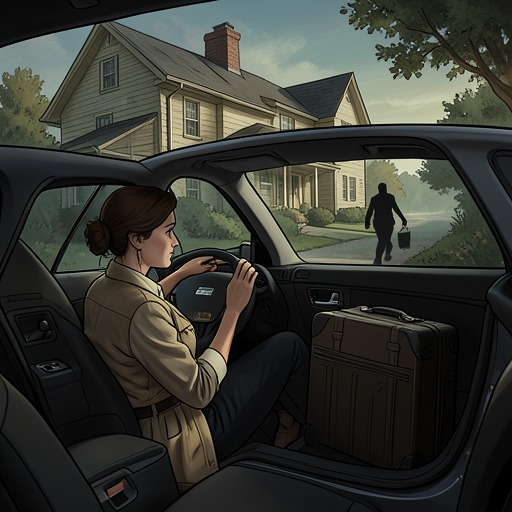
At nine minutes after four, Rosemary dresses, takes the emergency money Guy keeps beneath his underwear, and puts an address book and vitamin capsules into her handbag. She takes the suitcase already standing by the bedroom door and leaves the apartment, but halfway to the elevator she turns back before setting out again. The small fold of cash, the practical papers and pills, and the suitcase make the departure an improvised attempt to secure options for herself, not a calm or formally arranged transfer of care.
At Dr. Abraham Sapirstein's office, the receptionist notices the suitcase and asks whether Rosemary is in labor. Rosemary says she is not, but insists that seeing the doctor is important. Though he is due to leave at five and another patient is waiting, the receptionist says she will tell him Rosemary is there. The exchange places her urgent request inside the ordinary routines of a medical office: she must make herself heard, explain why she has come, and wait for access to a doctor whose care she no longer trusts.
Reaching Dr. Hill
Rosemary later walks up Park Avenue to Eighty-first Street and calls Dr. Hill from a glass-walled phone booth. She asks his service to have him call back immediately, identifying the matter as an emergency. When he reaches her, she says she has gone to another doctor and believes he has lied to her and given her unusual drinks and capsules. She reminds Dr. Hill that he had calculated the baby's due date as June 28 and asks him to deliver the child, offering to pay as though she had remained his patient throughout.
She does not stop at asking for a different doctor. Rosemary tells Dr. Hill that Guy, Dr. Abraham Sapirstein, and the people who directed her to him are involved in a plot against her and her baby. She anticipates that he may think she has lost her sanity, but insists that plots against people can exist and asks only to be admitted to a hospital for delivery. When Dr. Hill proposes that she come to his office the following day, she presses for help at once, saying that the others will be looking for her. Her insistence gives the urgency of the escape its shape: delay, to her, is not an inconvenience but exposure to the people she is trying to evade.
Rosemary waits in a theater, sitting through a film in its cool darkness and trying, without success, to reach her brother Brian by collect call. At twenty minutes to eight she takes a taxi to Dr. Hill's office on West Seventy-second Street. Believing that her acquaintances' homes may be watched, she asks the driver to wait and watch until she gets inside. No one stops her. Dr. Hill opens the door himself; despite his earlier reluctance on the telephone, he receives her pleasantly and takes her into his consulting room.
Her Account and the Attempted Rescue
Rosemary tells Dr. Hill what has happened, speaking quietly and trying to keep the events in sequence because she knows that any appearance of hysteria could make him dismiss her as mentally ill. Her account ranges from Adrian Marcato and Minnie and Roman Castevet to the pain, herbal drinks, and little white cakes. She recounts Hutch, All Of Them Witches, the Fantasticks tickets, black candles, and Donald Baumgart's necktie, as well as Dr. Shand's recorder, Guy's disposal of the book, and the receptionist's unwitting final revelation. The disorder of the telling does not erase its evidentiary force: separate objects, conversations, and reversals accumulate into a case she wants Dr. Hill to understand.
She allows that Hutch's coma and Donald Baumgart's blindness might have been coincidences, or might reflect some way of harming people, but says that the crucial fact is the group's interest in the baby. Dr. Hill acknowledges that the group's attention to the pregnancy from the beginning lends weight to her concern. He has met Guy once or twice; when Rosemary observes that a person might never suspect him by looking at him or speaking with him, Dr. Hill agrees that appearances can mislead. He asks whether she would like to go to Mount Sinai Hospital that evening. Rosemary welcomes the prospect, and he says that arranging it will require persuasion and influence before telling her to lie down and rest while he examines her.
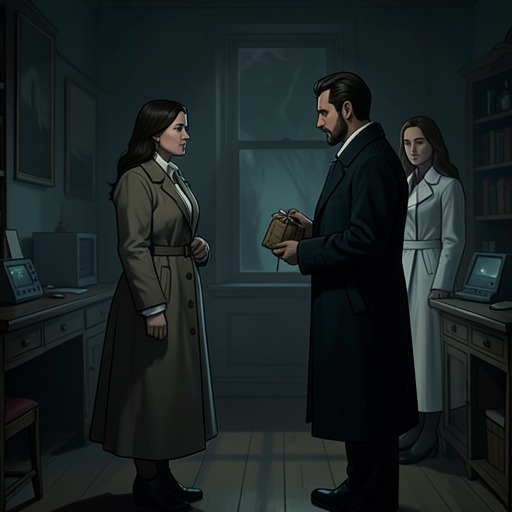
The hoped-for rescue does not hold. The narrative later places Rosemary in Dr. Hill's examining room again, four months after the baby's birth, while she is living with Brian and Dodie in Los Angeles. Dr. Hill opens the door and Dr. Abraham Sapirstein and Guy enter. Guy avoids looking at her at first. Dr. Abraham Sapirstein tells Rosemary to come quietly and threatens that continued talk of witches could lead to her being taken to a mental hospital, where delivery facilities would be inferior. Guy says they will take her home and that no one will hurt her; Dr. Abraham Sapirstein picks up the bottle of capsules and puts it in his pocket. The reassuring language is paired with a threat and the removal of the medicine, leaving little room for Rosemary to consent freely.
They leave with her in a car driven by Mr. Gilmore, Rosemary seated between Guy and Dr. Abraham Sapirstein. Nobody speaks on the drive to the Bramford. The return reverses the purpose of her flight: the place she sought as a route to independent care becomes the point from which she is forcibly reclaimed.
Consequences and Significance
The coercion becomes explicit when Guy and the others later approach Rosemary with a loaded hypodermic, calling themselves her friends and describing the injection as a mild sedative. She strikes at Guy with the telephone receiver and tries to call for help, but he catches her wrist while Mr. Fountain restrains her other arm. They silence her and hold her so Dr. Abraham Sapirstein can inject her. During the struggle, a severe contraction reveals that she is in labor. The delivery is taking place at the Bramford, contrary to her expectation that she would be at Doctors Hospital with its equipment, nurses, and sterile surroundings.
After this failure to secure an outside rescuer, Rosemary decides she must act alone rather than rely on the police, friends, or family to believe her. She reasons that Guy's acting and Dr. Abraham Sapirstein's professional reputation could make even Brian interpret her accusations as madness. Her later discovery of a concealed route from her apartment to the Castevets' apartment turns that resolve into a practical plan: she recognizes that the chained door cannot explain how the others entered and identifies the linen closet as the likely hidden passage. In this way, the escape attempt does not end the danger, but it changes what Rosemary knows about its workings and why she must avoid depending on other people to reach her child.
The episode's force lies in the contrast between a medical appeal and the means used to defeat it. Rosemary asks for a hospital delivery and explains her fears; the response she receives from Guy and Dr. Abraham Sapirstein is not an open assessment of her wishes but a threat of psychiatric confinement, a return by car, and, later, restraint and injection. Her effort to preserve her own judgment is repeatedly recast as evidence that she is unstable. The Bramford's apartment, elevator, offices, and concealed passageways form a domestic geography in which movement appears possible but can be watched, interrupted, or redirected. Seeking Dr. Hill gives Rosemary a brief opening beyond that system, and its closure sharpens the resolve with which she eventually acts without expecting rescue.